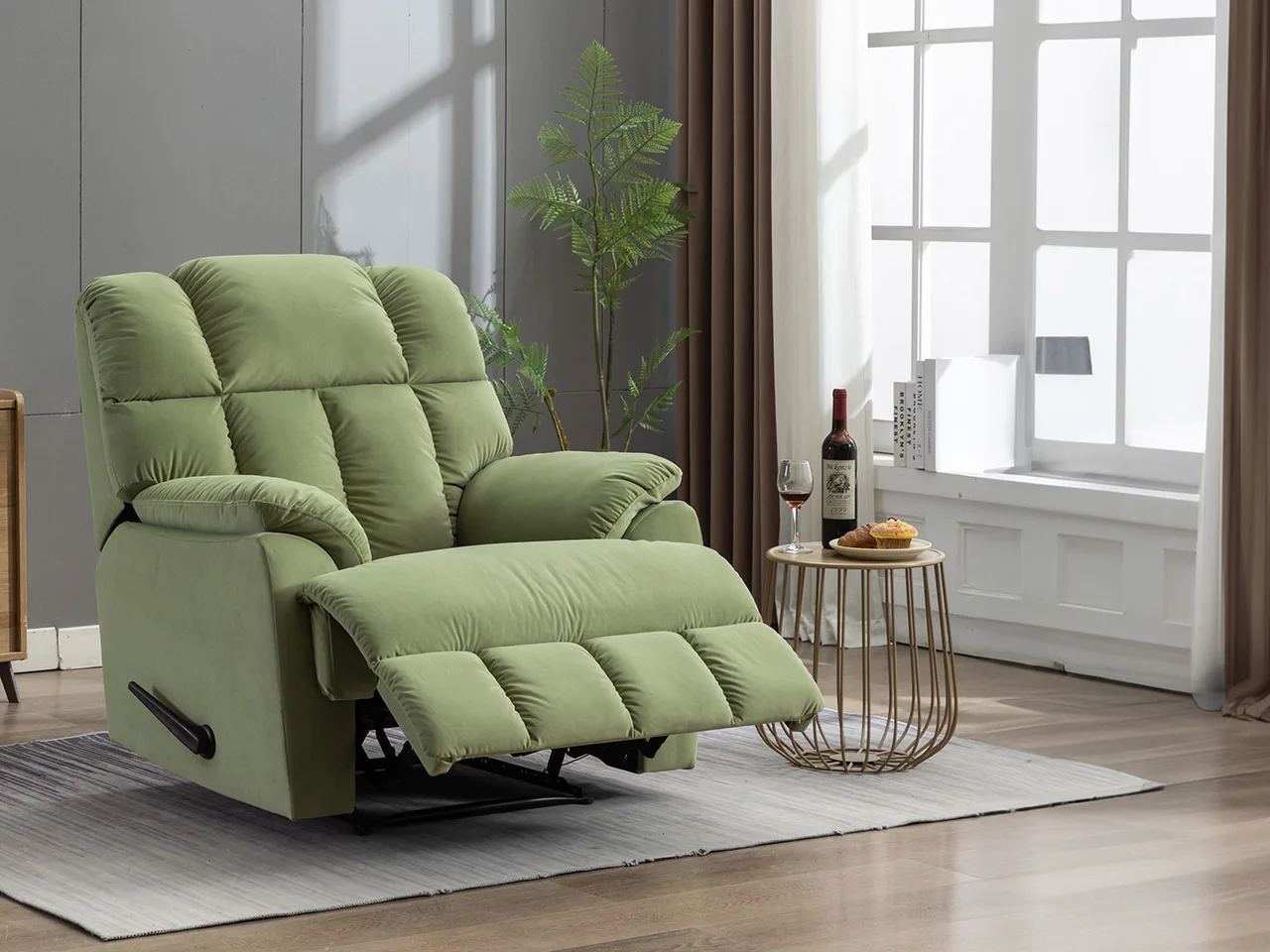
When a power sofa fails in the field, it is almost never the leather and almost never the frame. It is the motor, the hand control, or the cable junction behind it. That is the part the buyer cannot see at the showroom and the part a price-driven supplier will swap to save a few dollars a unit. So when we quote a power recliner, the actuator is one of the first lines we pin down, not the last.
Who actually makes these motors
There is no mystery about the supply base. The actuators behind most power recliners come from a short list of specialists — DewertOkin (the OKIN name), Limoss, Kaidi, TiMOTION and a few others. You will see their model codes on replacement-parts sites: Okin JLDQ series, Limoss MD140 and MD141, Kaidi KDYJT, Mulin ML18. We work with units from that tier rather than an unbranded motor with no model number, because when a customer needs a spare three years out, a real model code is the difference between a quick replacement and a scrapped sofa.
Ask any supplier — us included — which actuator brand and model goes into your sofa, and get it in writing. "A good motor" is not an answer. A model code is.
Single motor, dual motor, and the console
A single-motor unit drives the footrest and backrest together on one track — simpler, cheaper, fine for a straightforward recliner. A dual-motor unit moves the footrest and the headrest or lumbar independently, which is what a buyer means when they say "infinite position." Dual motor costs more and adds a second failure point, so we only push it where the product is sold on that feature. For a value line, a clean single motor is the honest call.
The console is where we see the most change requests: a USB-A port was standard for years, but more markets now ask for USB type-C, and some want both. We can fit either, but decide early — switching the console after the first sample resets part of the tooling for the arm cavity.
The power supply and hand control are part of the spec
A motor does not run on its own. Behind it sit a transformer/power supply and a hand control, and both are common failure points that buyers forget to specify. The power supply has to match the destination voltage — 110-120V for North America, 220-240V for Europe and most of Asia, so a single SKU cannot serve both regions without a swap. Battery backup packs are an increasingly common ask, because a customer hates being stuck reclined during a power cut; they add cost and we only fit them where the market wants them. The hand control should be the connector type your service network can actually source — the common round multi-pin plugs are widely interchangeable, which is exactly why we prefer them over a proprietary plug nobody can replace.
The trade-off, stated plainly
Here is the line we give buyers. The cheapest motor we can source will work on the test bench and through the first year. For a sofa that gets reclined a couple of times a night for years, that saving comes back as service calls, a courier sending replacement actuators across an ocean, and a retailer who stops reordering. We would rather quote a named actuator with a stated cycle life and let you compare like for like. The few dollars saved per unit on the motor is the most expensive few dollars on the whole sofa.
One more practical note: power sofas need their motors immobilised in transit, or the actuator arm works loose against the carton and arrives noisy. That is part of why we talk about how functional pieces are packed as carefully as how they are built. We strap the mechanism in its closed position and foam-block the moving arm, then function-test a sample from the lot — recline, stop, return — before the carton is sealed. It adds a few minutes per unit on the line and removes a whole category of arrival complaints.
What we ask before quoting
To quote a power programme properly we need four things: the destination market and voltage, the number of motors and positions you want, whether the console needs USB-A, type-C or both, and whether battery backup is required. With those answers we can name a specific actuator, its rated cycle life and the power-supply spec, instead of quoting a vague "power mechanism" that hides what you are actually buying. The same discipline runs through how we handle electrical safety for contract orders, where the motor system has to clear a recognised standard rather than just work.
Tell us the markets, the position count you want, and whether the console needs USB-C, and we will quote a specific actuator with its rated cycle life. We build to BIFMA/EN methods and motor safety can be tested per order. Reach the export desk through our contact form or write to [email protected]. How a private-label run works is on our OEM/ODM page.