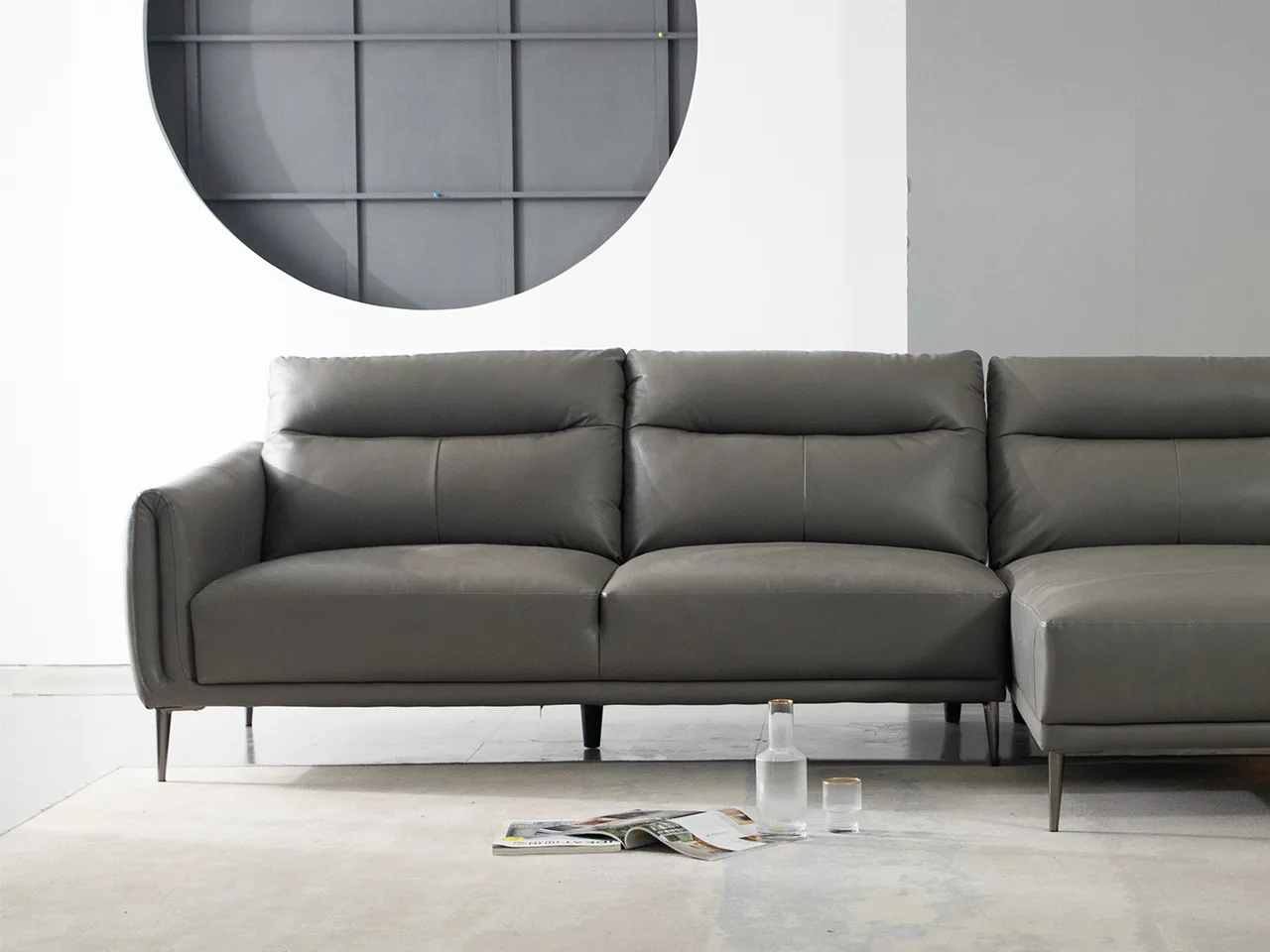
Sectionals are where new importers lose money, and almost always on the same mistake: the chaise ends up on the wrong side, and half the container is hard to sell. The fix is not complicated, but it depends on everyone agreeing on one thing — which way you are facing when you say "left."
LAF and RAF, settled once
LAF means left arm facing and RAF means right arm facing, judged as you stand in front of the sofa looking at it. So a LAF chaise sits on your left as you face the piece; a RAF chaise sits on your right. The single most common configuration is the simplest: a chaise on one end joined to a two- or three-seat sofa. Lock the viewpoint with your factory in writing — "facing the sofa" — and you remove the one ambiguity that turns into a return.
Chaise length and why it matters for stock
A chaise has to be long enough for one person to actually stretch out, which in practice means roughly 60 to 65 inches. Too short and it reads as a wide armless seat, not a chaise; too long and it dominates a small room and slows your sell-through. We hold standard chaise depths so a buyer can mix our sectional pieces across orders without the dimensions drifting between containers.
The common shapes, and who they suit
Most sectional demand comes down to a few shapes. A sofa-with-chaise is the entry configuration and the easiest to stock. An L-shape adds a longer return and suits open-plan rooms. A U-shape or "pit" wraps three sides and sells to buyers furnishing a media room, but it is bulky to ship and slower to turn, so we steer first-time importers away from loading a container with them. Armless "build your own" modules sit at the flexible end. Matching the shape mix to your market is half the order: a small-apartment market wants chaise and L-shapes; a large-home market can absorb U-shapes. We will give you a read on which shapes move where, based on what ships to those regions.
Modular vs fixed
A fixed sectional ships as a set configuration. A modular range ships as armless seats, corner pieces and one-arm ends that a customer combines — which is harder to make consistent but far easier for you to stock, because the same SKUs cover L-shapes, U-shapes and a straight sofa. The trade-off is real: modular needs tighter tolerances so pieces line up across production runs, and it needs connectors that hold. For a buyer who wants to offer "build your own," modular earns its extra cost; for a single hero SKU, a fixed sectional is cheaper and simpler.
Connectors, alignment and the returns nobody photographs
The part of a sectional that fails quietly is the join. If the connectors are weak or the pieces do not line up, the sofa walks apart under use and the seat cushions never sit flush — and a customer who cannot keep the two halves together simply returns the set. We use metal bracket-and-hook connectors on modular pieces rather than fabric straps or plastic clips, and we hold the seat heights and arm heights tight across a run so a corner ordered in March lines up with a seat ordered in September. For an importer building a modular range over several orders, that cross-batch consistency is worth more than any single spec on the sheet, because it is what lets a customer add to a set later.
The trade-off on your order mix
Here is the practical advice. For a first order, do not split your container 50/50 LAF and RAF on a guess. Most markets skew slightly toward one orientation, and the safe play is to weight toward the common one and keep the minority as a smaller line you can reorder. We will quote both orientations at the same price and help you plan the load so a mixed sectional order does not waste a layer in the container. Designs sold on powered headrests also carry the motor questions from our recliner notes — worth reading before you spec. And the same foam-density logic applies: a long chaise that someone lies on full-length needs the support density of a seat, not the softer fill you might use on a back cushion.
Send us the room sizes and markets you are selling into and we will recommend a configuration mix and chaise length, then quote LAF and RAF together. We build to BIFMA/EN methods and testing can be arranged. Reach the desk via the contact form or [email protected].