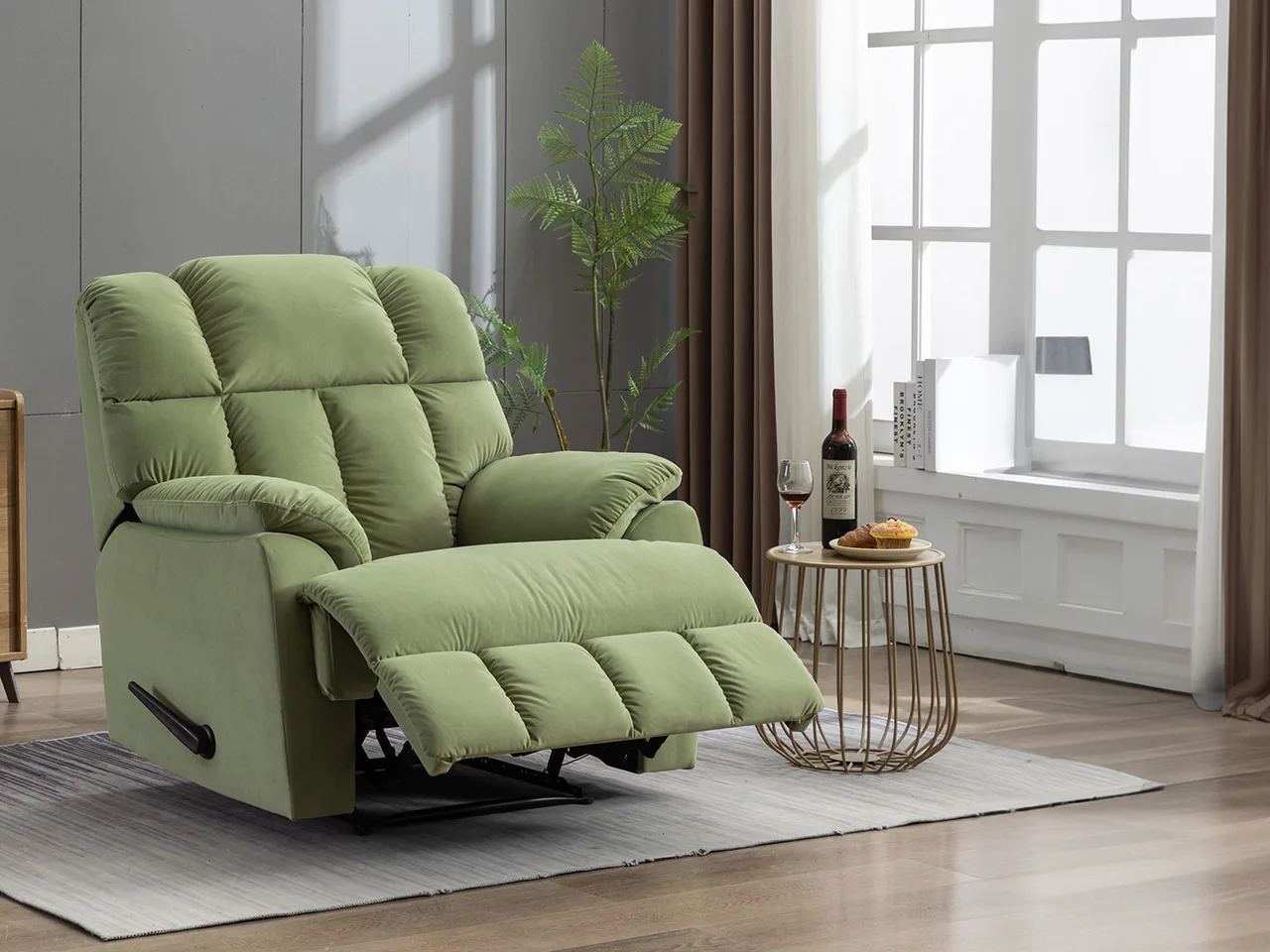
One of the first numbers a serious buyer asks is "how many sofas fit in a 40HQ?" It is the right question, because for furniture the loading plan moves your landed cost more than a few dollars on the FOB price ever will. The honest answer starts with a fact: with sofas, you almost always run out of space long before you run out of weight.
The volume you actually have
A 40-foot high-cube container gives you roughly 67 to 76 CBM of usable internal volume. Sofas are bulky and relatively light, so you cube out — you fill the space and the container is nowhere near its weight limit. That single fact drives the economics: with sofas you are buying air unless you pack the volume intelligently. Your freight cost is set by cubic metres, not by kilos.
Assembled vs knock-down
This is the lever that matters. A fully assembled three-seat sofa is mostly air inside the carton, and you might fit a few dozen in a container depending on size. The same sofa shipped knock-down — back, seat, arms and legs flat-packed — can stack into clean rectangles and lift the count substantially, because cartons that nest as boxes waste far less space than finished shapes. Modular sectionals take this furthest, since the pieces pack flat and combine at the destination.
Here is the trade-off, and it is genuine. Knock-down cuts your freight per sofa and suits distributors with a warehouse and labour. But it pushes assembly time and assembly errors onto your side, and for a buyer drop-shipping to homes, an assembled sofa that arrives ready to sit on is worth the worse cube. Power recliners complicate it further — the motor and wiring limit how far you can break the piece down, so they ship closer to assembled.
Carton strength is part of the load plan
Cubing efficiently means nothing if the cartons crush. Sofas get stacked two and three high in a container and then again in a warehouse, so the bottom carton carries real load for weeks. We spec the carton board by edge-crush rather than guessing — five-ply for heavier pieces, with corner protectors on anything with a hard frame edge — because a collapsed bottom carton damages the sofa inside it and every sofa above it. A buyer comparing two quotes should ask what board the supplier uses; a thin three-ply carton is a cost saving you pay for in transit damage. This matters most for the heavier solid-hardwood frames, which are exactly the pieces you do not want arriving scuffed.
How we plan a load
When we quote a sofa programme, we send a loading plan, not just a unit price: cartons per container, CBM per carton, and the count for both assembled and knock-down where the model allows it, so you can compare landed cost yourself. If you are new to this, the container loading guide on ChairManufacturer.net covers the fundamentals of loading plans and carton stacking that apply equally to sofas. If you are mixing recliners, sectionals and a few beds, we plan the stack so the bulky pieces do not strand a half-empty layer. Mixing models is often the most efficient load, because a small flat item can fill the gap a bulky one leaves — but only if it is planned before packing, not improvised at the dock.
One caution from experience: do not let a supplier quote you the absolute theoretical maximum. That figure assumes a perfect load with no dunnage and no door-end gap, and real containers never load that cleanly. We quote a realistic count and would rather under-promise it than leave you short on a reorder.
20ft, 40ft or 40HQ — which to book
Because sofas cube out, the high-cube 40 (the "HQ") is almost always the right box for furniture: the extra foot of height over a standard 40ft turns into a usable extra layer for tall items, and the cost difference over a standard 40ft is small relative to the volume you gain. A 20ft container holds roughly a third less than a 40HQ, so it only makes sense for a small first order or a trial SKU where you would rather move less stock than fill a big box slowly. The mistake we see is a buyer booking a standard 40ft to save a little, then leaving a half-layer of unusable headroom that a 40HQ would have filled. Tell us the quantity and we will tell you honestly whether it justifies a 40HQ or whether a 20ft is the cleaner economic call for a first run.
FOB, CBM and what your quote actually includes
One last point that trips up newer importers: an FOB price per sofa and a freight cost per CBM are two different numbers, and the cheapest FOB does not always win once you add the freight. A bulky sofa with a low FOB can cost more landed than a tighter-packing one with a slightly higher FOB, because it eats more cubic metres. That is the whole reason we send the loading plan alongside the unit price — so you can do the landed-cost sum yourself rather than discovering it after the container is booked.
Send us your models and quantities and we will return a real 40HQ loading plan, assembled and knock-down where it applies. Reach the export desk via the contact form or [email protected].