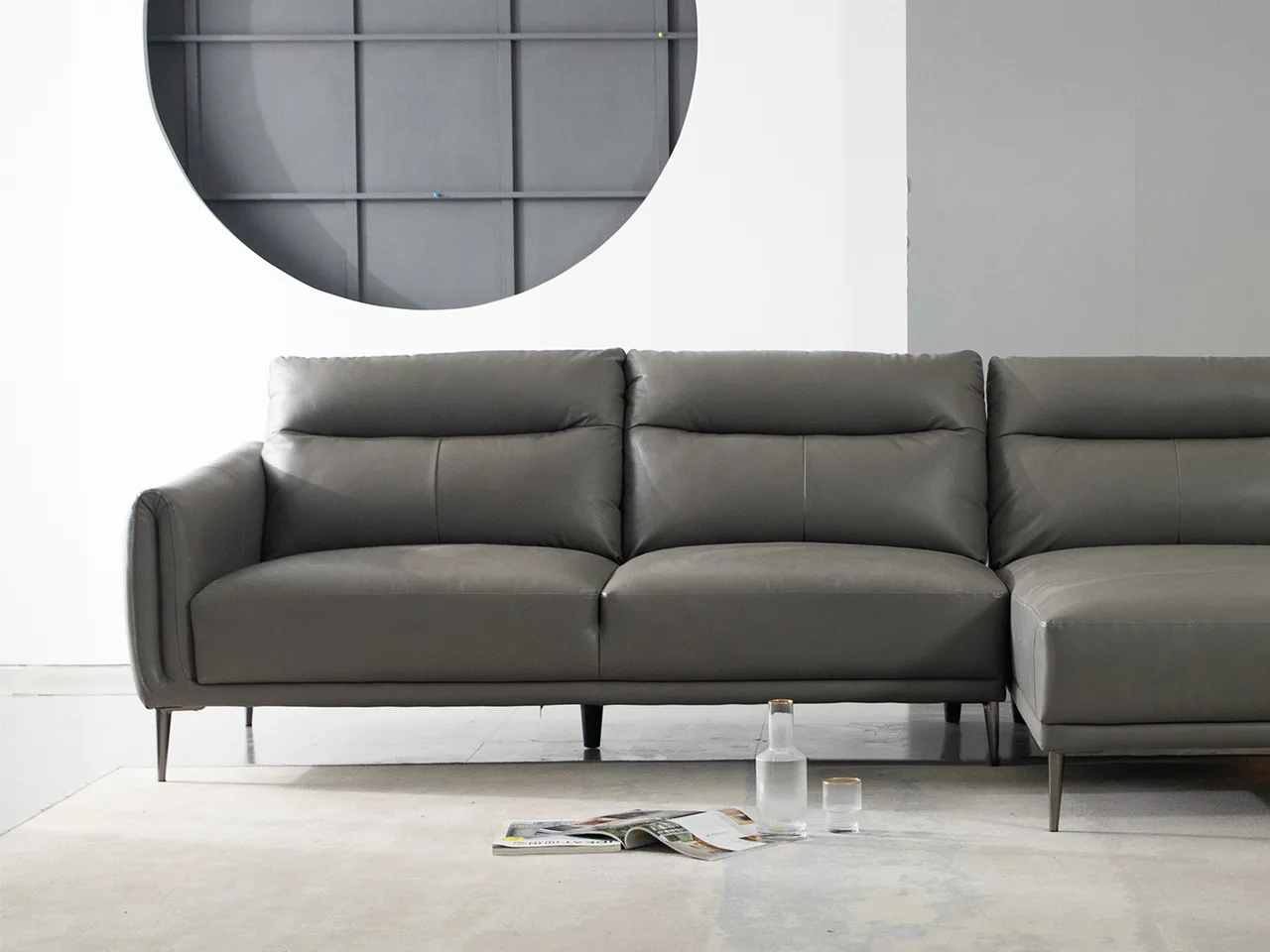
Most cushion conversations start and stop at foam density, and we have already written up how to read the kg/m³ number — none of that changes here. But density only describes one layer. The way a cushion is built around that layer is a separate spec, and it is the one that decides whether a customer's photo in year three shows a seat that held its shape or a pancake with a dent in it. We build four constructions. Here is how each behaves once the showroom honeymoon ends.
All-foam: predictable, tailored, firm-ish
The simplest build is a shaped foam core, sometimes with a softer comfort layer glued on top. It holds a crisp, tailored cushion line, it never needs plumping, and its ageing is entirely a function of the core quality — get the density and resilience right and an all-foam seat is the most predictable thing we make. The honest limit is the feel: foam alone never gives the sink-in softness some markets expect, and a cheap core has nowhere to hide. On recliners, where the seat is fixed to the mechanism platform and cannot be flipped or rotated, all-foam (or foam over a coil unit) is what we recommend, because a wrap that flattens cannot be fluffed back on a fixed seat.
Fibre-wrapped foam: the showroom favourite
Wrap the same core in a layer of polyester fibre and the cushion gains a soft crown and a plumper first impression — which is exactly why it is the most common build in e-commerce photography. The trade-off arrives early: fibre compresses faster than foam, so the crown flattens over the first year and the cushion starts to look casually rumpled even though the core underneath is fine. That is cosmetic, not structural, but an online customer does not make that distinction in a review. If the SKU sells on a plump look, the fibre layer needs to be generous and the casing needs channel stitching so the fill cannot migrate into the corners.
Feather-blend wraps: the premium feel with homework
Replace the fibre with a feather-blend wrap around the foam core and you get the soft, expensive sink that premium lounge buyers want. The year-three story depends almost entirely on the casing: a plain bag lets the fill migrate and clump, while a channelled or baffled casing holds it in place. And feather needs plumping — a feather-wrap cushion that nobody fluffs takes on a lived-in slouch within months. For the right market that reads as relaxed luxury; for a buyer expecting a tailored line it reads as worn out. We tell importers plainly: do not put a feather wrap on a value SKU sold to customers who will never plump a cushion. It will be your most-photographed complaint.
Foam over pocket coils: the recovery play
The fourth build puts a unit of individually wrapped springs inside the seat core, with foam around it and fibre over it. The coils do for a cushion what they do for a mattress: they push back. Recovery after each sit is faster, body impressions form more slowly, and the seat keeps its loft past the point where an equivalent all-foam seat has started to settle. It costs more, adds weight, and the spring unit must be sized so the perimeter foam wall does not collapse around it — a badly built coil cushion telegraphs its springs through the seat, which is worse than either build done properly. For family sectionals aimed at daily heavy use, foam-over-coil is the construction we push, because it is the one that still looks saleable in the year-three photo.
Backs are a different animal
Back cushions carry a fraction of the load, so chasing seat-grade specs there is wasted money. Fibre or feather-blend fills in a channelled casing do the job; the only real failure mode is migration, which stitching solves. Spend the upgrade budget on the seat — it is the layer that fails first and the one warranty claims are made of. The springs and frame underneath still matter as much as the cushion sitting on them; soft cushion over weak suspension sags twice as fast, so we spec the stack together.
Reversible or fixed: the maintenance question
One structural choice cuts across all four builds: whether the seat cushion is loose and reversible or sewn to the deck. A reversible cushion doubles its cosmetic life, because the customer can flip and rotate it — which is also why the fill must be symmetrical, with the same wrap on both faces. A fixed seat looks tidier in photos and cannot be put back wrong, but every hour of use lands on the same face, so the construction underneath has to be a grade tougher. We ask about this before we ask about the cover, because a fixed-seat sectional with a fibre-wrapped budget core is a complaint with a delivery date on it.
How to order this without getting fooled
Make the construction a written line on the quote, not a photo interpretation: core density, wrap type and weight, casing stitching, and coil count if there is a spring unit. A showroom sample cannot tell you what year three looks like, but the spec sheet can — a generous fibre wrap over an under-density core feels identical on day one to a proper build and costs several dollars less, which is precisely why it gets quoted. We put the construction in writing on every OEM/ODM program so that what arrives in container twelve matches the golden sample from container one. We build and test to BIFMA/EN methods and cushion durability testing can be arranged per order.
Tell us your market, your price point and whether your customers plump cushions or expect zero maintenance, and we will recommend a construction per SKU with the spec in writing. Reach the export desk via the contact form or [email protected].